
Partner with Hire Chore and focus on your strengths.
*100% free, no-obligations consultation to determine your Ops blockers

Enter your info to receive the guide instantly.
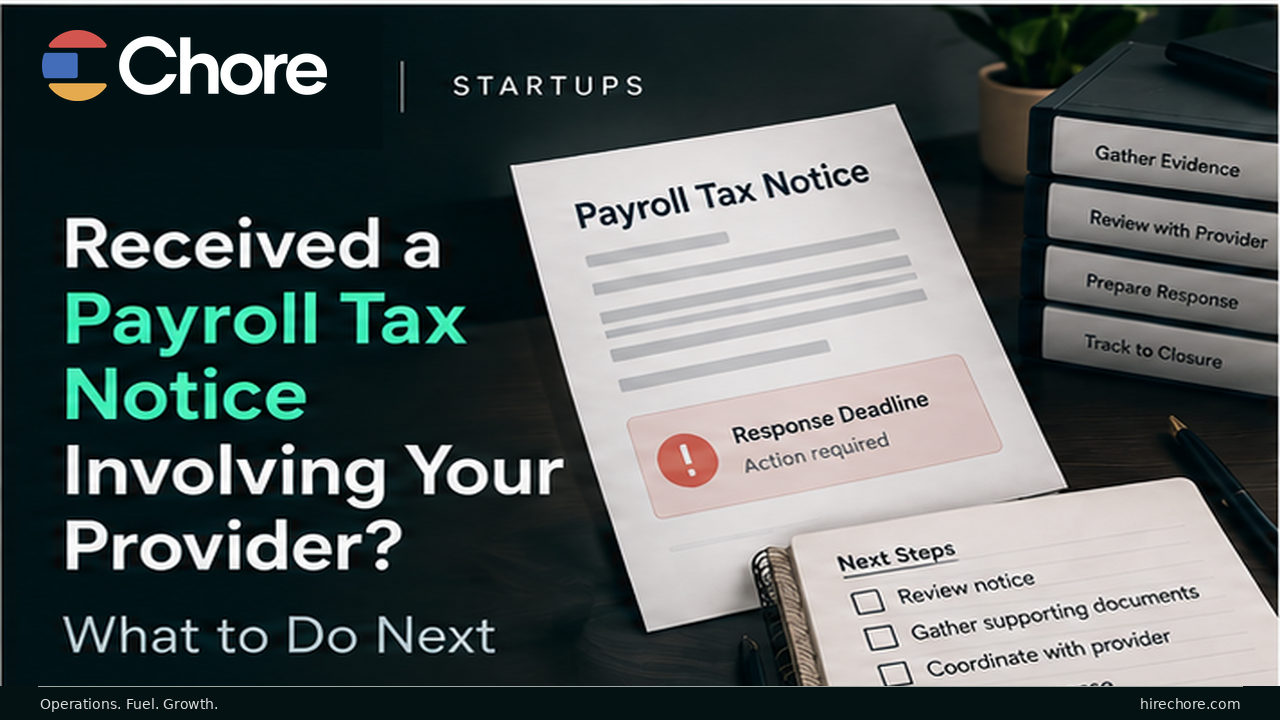
A payroll tax notice is not proof that your payroll provider caused the problem.
The first job is to protect the deadline, preserve the notice, identify exactly what the agency alleges, and compare that allegation with the payroll, filing, payment, and provider records for the affected period.
Treat the notice like an incident, not a blame exercise.
Your response process should answer five questions:
1. What exactly is the agency saying?
2. What is the response deadline?
3. Which payroll provider or third-party arrangement covered the affected period and task?
4. What evidence supports or contradicts the allegation?
5. Who owns the next action until the agency confirms the matter is closed?
For IRS notices, the IRS says to review the notice carefully, keep it for your records, and respond by the due date when a response is required. If you disagree, follow the notice instructions and include supporting documentation. The printed agency deadline still matters even if your payroll provider has opened a support case.
This article is an operational response framework, not tax or legal advice. Payroll-tax notices can involve payment, filing, penalty, representation, appeal, and liability questions. A qualified CPA, Enrolled Agent, tax attorney, or payroll-tax specialist should review consequential response or dispute decisions before publication-ready use of this framework.
Step 1: capture the notice before doing anything else
Create one incident record and preserve the original notice.
Record:
- issuing agency;
- notice or letter number;
- notice date;
- delivery date;
- tax type;
- entity and EIN or account number shown;
- affected tax period;
- amount, if any;
- the issue the agency says exists;
- response deadline;
- payment deadline, if different;
- stated response channel;
- contact details printed on the notice;
- provider in place during the affected period; and
- current internal owner.
For an IRS notice, use the notice number to look up the official IRS guidance and compare the contact or response instructions with the IRS site. If a message looks suspicious or the notice cannot be verified, do not rely on an unexpected email, text, or third-party link.
Do not alter the original. Store the notice, envelope or electronic-delivery record, and every page together.
Step 2: classify the notice without deciding who is at fault
A useful first-pass taxonomy is:
- informational notice;
- deposit or payment not found;
- late or insufficient deposit;
- missing return;
- return mismatch;
- balance or credit mismatch;
- account or entity mismatch;
- proposed penalty;
- collection notice;
- filing-frequency or rate notice;
- state unemployment notice;
- other agency-specific issue.
The category helps you decide what evidence to pull.
It does not establish cause.
A missing-payment notice might reflect a provider failure, a payment applied to the wrong period, an EIN problem, an agency processing issue, a prior-provider obligation, or something else. The evidence has to decide.
Step 3: map the affected period to the actual provider arrangement
This is where many notice responses go wrong.
The IRS distinguishes among payroll service providers, reporting agents, section 3504 agents, CPEOs, and other third-party payer arrangements. Those arrangements can carry different filing authority and liability rules.
For example, IRS guidance says a payroll service provider may prepare returns and make federal tax deposits using the employer's EIN, while a reporting agent is authorized through Form 8655 for specified acts. A CPEO can have a different employment-tax role.
So before sending the notice to the current provider and assuming it owns the problem, record:
- which provider served the company during the affected period;
- the start and end dates of that service;
- the exact tax services in the contract;
- whether the provider was acting as a PSP, reporting agent, CPEO, or another arrangement;
- which EIN or account the filing or payment should appear under;
- applicable authorization forms;
- whether the obligation belonged to the prior or current provider; and
- any transition-period responsibility agreement.
The key rule is simple:
Do not infer responsibility from the logo on your current payroll dashboard.
Step 4: build the evidence packet
Collect the evidence before choosing a response branch.
Your evidence packet may include:
- the complete agency notice;
- payroll-provider service agreement or scope;
- provider implementation or cutover documents;
- payroll registers for the affected period;
- tax-liability reports;
- federal or state deposit confirmations;
- EFTPS or agency-account payment history, where applicable;
- filed returns;
- electronic filing or acceptance confirmations;
- Form 8655 or other authorization records;
- bank records showing tax funding or provider withdrawals;
- provider case numbers and correspondence;
- prior notices about the same period;
- amended return records, if any;
- agency account transcripts or portal history, if available; and
- internal accounting records needed to tie the amount.
Do not confuse these evidence types.
A provider dashboard that says “paid” is provider-side evidence. A bank debit proves money left an account. An agency payment history or acknowledgment is government-side evidence. A filed return confirmation is filing evidence.
They answer different questions.
Step 5: reconcile the allegation before selecting the response
Build a simple control table:
| Notice allegation | Provider record | Agency record | Difference | Owner | Next action |
|---|---|---|---|---|---|
| Example: Q2 deposit missing | Provider says submitted | Payment not visible / misapplied | Open | Payroll-tax specialist | Trace confirmation and agency account |
| Example: Return missing | Provider says filed | No acceptance evidence | Open | Provider + tax adviser | Obtain filing acknowledgment / verify agency record |
| Example: Balance due | Liability report differs from return | Agency balance matches filed return | Open | Controller / CPA | Reconcile underlying tax liability |
Then choose the appropriate branch.
Branch A: the notice appears correct
Follow the agency's notice-specific instructions and obtain qualified review where the action is consequential.
The correct next step might involve a payment, return, amendment, documentation submission, provider correction, or another action. Do not turn a generic article into notice-specific tax advice.
Branch B: you disagree with the notice
For an IRS notice, the IRS says to follow the dispute instructions in the notice, include supporting information or copies of documents, and reply by the due date to protect appeal rights.
Before sending a consequential dispute, have the response reviewed by the appropriate qualified professional.
Branch C: the provider has evidence the agency does not appear to reflect
Get the provider's submission or payment evidence and compare it to the agency account details.
Ask:
- Was the correct EIN or account used?
- Was the correct tax type or form used?
- Was the correct tax period used?
- Was the amount correct?
- Did the payment settle?
- Was the return accepted?
- Was the item later reversed, rejected, or returned?
- Does the agency need a trace, correction, or other notice-specific procedure?
Do not make a duplicate payment simply because the original payment is not immediately visible. Confirm the account and remedy with the provider, agency, and qualified adviser first.
Branch D: the notice covers a period outside the current provider's scope
Do not send it into an endless current-provider queue.
Identify the provider or company owner responsible for that period and preserve the handoff evidence. If the notice exposes a weak provider-transition boundary, fix that process separately.
Branch E: you suspect improper or fraudulent provider conduct
This is a special escalation path, not the default explanation for a mismatch.
The IRS identifies Form 14157 as a complaint route when a payroll service provider is suspected of improper or fraudulent activity involving federal tax deposits or returns.
Do not use a fraud-complaint path simply because the provider and agency records disagree. Escalate only when the facts support it and obtain qualified advice where appropriate.
Step 6: keep the agency deadline separate from the provider support case
A payroll provider may ask you to upload the notice and open a case. That can be useful.
But “provider case opened” is not the same as “agency deadline protected.”
Track both:
| Control | Record |
|---|---|
| Agency deadline | Date printed in the notice |
| Required agency response | What the notice actually asks for |
| Provider case number | Ticket / case reference |
| Provider owner | Named support or tax-contact owner |
| Evidence sent to provider | Files and date sent |
| Agency response submitted | Method, date, and confirmation |
| Qualified adviser | Name / role if used |
| Next follow-up | Date |
| Escalation date | Date if no meaningful progress |
| Closure proof | Agency acknowledgment / account update / corrected filing or payment evidence |
If the provider says it needs more time, that does not automatically extend the agency deadline.
Only the issuing agency or the governing procedure can determine whether an extension, alternative response date, or other relief applies.
Step 7: define “closed” properly
A provider ticket marked “resolved” is not enough.
Close the internal incident only when the company has the evidence appropriate to the issue, such as:
- agency acknowledgment of the response;
- updated agency account status;
- payment properly posted;
- corrected return accepted;
- penalty or balance adjusted as applicable;
- requested information accepted;
- written agency correspondence;
- a documented professional conclusion that no further action is required; and
- preventive follow-up assigned internally.
Keep the evidence packet with the incident record.
If the matter remains open, record:
- current status;
- outstanding issue;
- next action;
- owner;
- next follow-up date; and
- escalation point.
A copyable Payroll Tax Notice Response Control Log
Use this as the minimum record:
| Field | What to record |
|---|---|
| Agency | IRS, state agency, local authority |
| Notice / letter number | Exact identifier |
| Notice date | Printed notice date |
| Delivery date | When company received it |
| Tax type | Employment tax / unemployment / withholding / other |
| Affected period | Quarter / month / tax year |
| Amount | If stated |
| Allegation | What the agency says happened |
| Response deadline | Printed deadline |
| Provider during period | Provider actually in scope then |
| Provider arrangement | PSP / reporting agent / CPEO / other / uncertain |
| Provider case | Case number and owner |
| Evidence packet | Links / locations |
| Company owner | Internal accountable owner |
| Qualified adviser | If required |
| Agency response | What was sent / done |
| Response proof | Confirmation / tracking |
| Next follow-up | Date |
| Closure evidence | Agency/account/correction evidence |
| Status | OPEN / WAITING ON PROVIDER / WAITING ON AGENCY / WAITING ON ADVISER / CLOSED |
Evidence Packet Checklist
Before escalating or disputing a provider-related payroll tax notice, check whether you have:
- Full notice and delivery record
- Provider contract / scope for the affected period
- Payroll register
- Tax-liability report
- Relevant return
- Filing acknowledgment / acceptance evidence
- Payment or deposit confirmation
- Agency account history where available
- Authorization records
- Bank funding record
- Provider case correspondence
- Prior related notices
- Internal reconciliation
- Qualified review if the response involves interpretation, dispute, amendment, appeal, representation, or relief
Decision tree
Did you verify the notice through the issuing agency's official channel?
- No: verify authenticity first.
- Yes: continue.
Does the notice relate to payroll and the affected period?
- No / unclear: route to the appropriate tax owner before treating it as payroll-provider work.
- Yes: continue.
Did the current provider actually cover that period and task?
- No: route to the correct prior provider / company owner / adviser.
- Yes or uncertain: document the arrangement and continue.
Do provider records and agency records agree with the notice?
- Yes, notice appears correct: follow notice-specific instructions with qualified review where needed.
- No: assemble the discrepancy evidence and determine whether the issue is provider-side, agency-side, filing-related, payment-related, account-related, or still unresolved.
Is a formal dispute, amendment, appeal, penalty-relief request, representation, or fraud complaint being considered?
- Yes: obtain qualified professional review before acting.
- No: complete the operational response, preserve confirmation, and keep tracking until agency-level closure.
Prevent the next notice
When the incident is closed, ask what upstream control would have surfaced the issue earlier.
Possibilities include:
- recurring payroll-tax deposit verification;
- independent access to agency payment history;
- better provider-transition responsibility mapping;
- pre-payroll input reconciliation;
- a notice inbox and named owner;
- regular filing-acceptance review; or
- stronger evidence retention outside the provider portal.
If the problem was a missing or misapplied payroll-tax deposit, the preventive control is not “trust the provider more.” It is independent payroll-tax deposit verification.
If the problem was a provider cutover, use the payroll-provider cutover checklist to update the responsibility matrix.
If the problem was a payroll-input error, fix the pre-payroll reconciliation control.
The incident should produce a better system, not just a closed ticket.
Where Chore fits
This article does not assume Chore is authorized to represent your company before a tax agency, provide tax or legal advice, file amendments, request penalty relief, or guarantee resolution.
If Chore's current service scope includes operational coordination around payroll records or provider follow-up, that role should be confirmed before relying on it.
When the issue requires interpretation, dispute, amendment, appeal, representation, relief, or a tax conclusion, work with the appropriately qualified professional.
The safe operating rule is:
Protect the agency deadline, preserve the evidence, assign the right owner, and keep the incident open until you have agency-level closure proof.

The Chore team consists of individuals from diverse backgrounds with a passion for learning and a desire to share knowledge.
Chore's content, held to rigorous standards, is for informational purposes only. Please consult a professional for specific advice in legal, accounting, or other expert areas.