
Partner with Hire Chore and focus on your strengths.
*100% free, no-obligations consultation to determine your Ops blockers

Enter your info to receive the guide instantly.
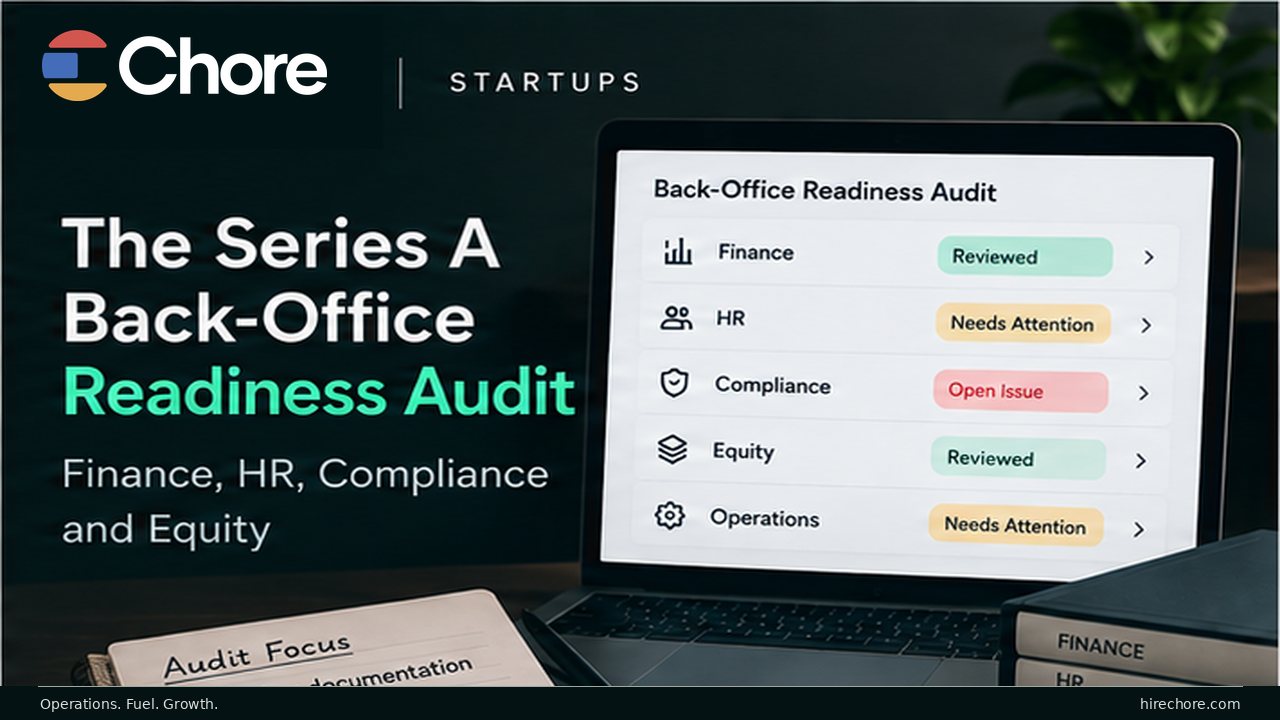
A Series A back-office audit is not a prediction of whether you will raise.
It is a way to answer a narrower, more useful question:
If investors, counsel, accountants, or advisers start asking for evidence tomorrow, can the company produce reliable records, explain material exceptions, and assign every gap to the right owner?
That is different from having a polished data room.
A startup can have every requested file uploaded and still have weak underlying books, missing approvals, inconsistent cap-table records, unresolved payroll-tax issues, or unclear ownership of critical systems.
Use this audit to classify each item as:
BLOCKS DILIGENCE
FIX BEFORE OUTREACH
MONITOR
Do not turn the audit into a fake fundraising score. There is no universal numeric threshold that predicts whether a company is “Series A ready.”
The point is to produce a prioritized remediation queue with evidence, owner, next action, specialist route, and retest date.
What this audit covers
Series A diligence can span much more than financial statements.
Y Combinator's Series A diligence checklist includes categories such as corporate records, business plans and financials, intellectual property, securities issuances, material agreements, disputes, employees, and employee benefits. (Y Combinator)
Cooley GO's sample VC due-diligence list likewise emphasizes organizing corporate and legal records early, while explicitly warning that the sample is not universal and that transaction-specific counsel or investors may ask for more. (Cooley GO)
So this audit is intentionally broad.
It looks at:
- finance and books;
- people and payroll;
- tax and compliance evidence;
- equity and cap table;
- governance and corporate records;
- material agreements and insurance;
- system access and continuity; and
- the remediation queue that ties those areas together.
It does not replace legal, tax, accounting, securities, payroll, benefits, insurance, or security advice.
Set the audit rule before reviewing anything
For every diagnostic, record:
- the question;
- required evidence;
- evidence link or location;
- current status;
- failure signal;
- severity;
- internal owner;
- qualified specialist, if needed;
- first remediation action;
- target date; and
- retest result.
Then apply one of three dispositions.
BLOCKS DILIGENCE
Use this when the gap could make a core representation unreliable or prevent the company from producing a material requested record.
Examples:
- books cannot be reconciled;
- cap table and legal records materially disagree;
- a key financing approval cannot be found;
- critical payroll-tax evidence is missing;
- ownership of a material contract is unclear;
- a required specialist conclusion is unresolved.
FIX BEFORE OUTREACH
Use this when the issue is important but can reasonably be remediated before diligence becomes active.
Examples:
- inconsistent filing organization;
- outdated system access;
- unsigned internal policy;
- missing documentation for a recurring control;
- small unresolved bookkeeping exceptions;
- weak owner assignment.
MONITOR
Use this when the item is currently acceptable but needs an owner, review date, or evidence refresh.
The disposition is an operating priority, not a legal or accounting conclusion.
Finance and books
Do not ask only:
Do we have a P&L?
Ask:
Can the material numbers in the package be traced to reliable books and supporting records?
The IRS's current Publication 583 says business records should support entries and that books and supporting documents are used to prepare financial statements and tax records. It is tax recordkeeping guidance, not an investor-readiness standard, but the evidence principle is useful here. (IRS Publication 583)
Audit:
- current balance sheet;
- profit and loss statement;
- cash-flow reporting where used;
- general ledger;
- trial balance;
- bank reconciliations;
- credit-card reconciliations;
- accounts receivable;
- accounts payable;
- payroll-related accounting;
- debt schedules;
- financing entries;
- historical corrections;
- supporting schedules;
- unresolved accounting exceptions; and
- monthly close ownership.
Evidence test
For a material balance or reported fundraising metric, can the owner trace:
source record → ledger → reconciliation / schedule → financial statement → reported number
If not, the issue is deeper than a missing PDF.
Failure signals
Examples:
- unreconciled cash accounts;
- unsupported opening balances;
- large unexplained journal entries;
- AR or AP schedules that do not tie;
- payroll records that do not tie to the ledger;
- inconsistent financing entries;
- unexplained historical changes; or
- no owner for the recurring close.
Detailed historical remediation belongs in the separate bookkeeping-cleanup procedure rather than inside this hub.
People and payroll
The audit should test whether the employee and payroll records tell one coherent story.
Review:
- current employee roster;
- legal entity employing each worker;
- payroll population;
- compensation approvals;
- active / terminated status;
- benefits enrollment and deductions;
- payroll-provider scope;
- payroll-system access;
- payroll-tax account visibility;
- payroll-tax notices;
- W-2 / year-end responsibility;
- contractor versus employee records where relevant; and
- unresolved jurisdiction-specific issues.
Do not turn this page into a payroll compliance manual.
The IRS currently says that employers who outsource payroll generally remain responsible for federal payroll-tax deposits and payments, subject to arrangement-specific exceptions such as certain CPEO structures. (IRS)
So the audit question is not:
Do we use a reputable payroll provider?
It is:
Do we know the arrangement, retain appropriate visibility, and have evidence that the relevant obligations are owned?
Route detailed work to the relevant process:
- pre-payroll reconciliation;
- payroll-provider cutover;
- payroll-tax notice response;
- payroll-tax deposit verification; or
- current payroll-tax deadline guidance.
Tax and compliance evidence
This audit should identify missing evidence and unresolved ownership.
It should not declare the company “compliant.”
Review:
- federal tax filings relevant to the company;
- state registrations;
- state tax filings;
- payroll-tax accounts;
- open notices;
- annual information returns;
- franchise / annual report obligations;
- required business registrations;
- unresolved tax or regulatory correspondence;
- adviser ownership; and
- evidence of completed filings / payments where applicable.
For each issue, ask:
- What obligation is this?
- Which entity and jurisdiction does it apply to?
- What evidence demonstrates the current status?
- Who owns the next action?
- Does a CPA, tax adviser, payroll specialist, or counsel need to decide the treatment?
Avoid generic claims such as:
“All Series A startups need X filing.”
Requirements depend on entity type, jurisdiction, workforce, business activities, financing history, and other facts.
Equity and cap table
A clean cap table is not just a spreadsheet with percentages that add to 100%.
The audit should test consistency among:
- cap-table platform or ledger;
- certificate / charter information;
- stockholder records;
- option grants;
- exercise records;
- board approvals;
- stockholder approvals where applicable;
- SAFEs;
- convertible notes;
- priced financing documents;
- warrant records;
- stock-plan documents;
- employee equity records;
- 409A records where relevant; and
- executed legal documents.
Y Combinator and Cooley diligence materials both include securities, equity, board actions, charter documents, and related records among common diligence categories. (Y Combinator) (Cooley GO)
The audit question is:
Do the operational records and executed legal approvals agree?
If they do not, do not let an operations checklist decide the legal answer.
Route ownership, issuance, approval, securities, and document conflicts to startup counsel or the appropriate qualified cap-table/legal owner.
Governance and corporate records
Corporate records should be findable before diligence starts.
Review:
- current certificate / charter;
- bylaws;
- board actions and minutes;
- stockholder actions where applicable;
- subsidiary records;
- corporate structure;
- material approvals;
- material agreements;
- financing documents;
- IP assignment records;
- disputes or threatened claims;
- insurance policies;
- record custodian; and
- document location.
The goal is not to have every imaginable document.
It is to know:
- what exists;
- where it is;
- which entity it belongs to;
- whether it is executed;
- whether the operational record matches it; and
- who resolves a gap.
Cooley explicitly frames its due-diligence list as a sample and says additional documents may be required. That is why the actual investor and counsel request should ultimately govern the transaction-specific package. (Cooley GO)
Material agreements and insurance
Review contracts that could matter materially to the business or financing.
Examples may include:
- major customer agreements;
- material vendor contracts;
- leases;
- debt agreements;
- licensing arrangements;
- IP agreements;
- partnership agreements;
- insurance policies;
- restrictive covenants;
- guarantees; and
- other agreements likely to appear in the investor or counsel request.
For each, capture:
- entity;
- counterparty;
- agreement date;
- term;
- renewal / termination provisions;
- location of executed copy;
- owner;
- related approval; and
- open issue.
Do not have an operations reviewer make legal conclusions about assignability, enforceability, change-of-control provisions, or financing consent requirements. Flag the issue and route it.
Access and continuity
This category is commonly missing from fundraising checklists.
A diligence period often exposes a different problem:
The records exist, but only one person knows how to access them.
Review critical systems:
- accounting;
- payroll;
- cap table;
- banking;
- cards;
- bill pay;
- expense management;
- billing / AR;
- cloud storage;
- HR;
- tax portals;
- state portals;
- insurance;
- contract repository; and
- other critical operational systems.
For each, ask:
- Who owns the account?
- Is there a company-controlled administrator?
- Is MFA enabled where supported?
- Are there inappropriate shared logins?
- Is access documented?
- Is the recovery method company-controlled?
- Can access be revoked?
- Can records be exported?
- Is there continuity if the current operator leaves?
Detailed outsourced-bookkeeping permissions belong in the separate access-and-control article. Here, the job is simply to identify continuity risk and assign it.
Build one consolidated remediation queue
The audit becomes useful only when failed checks turn into work.
Use one queue:
| Field | What to record |
|---|---|
| Category | Finance / payroll / tax / equity / governance / agreements / access |
| Diagnostic | The question that failed |
| Evidence missing / weak | What is absent or unreliable |
| Disposition | BLOCKS DILIGENCE / FIX BEFORE OUTREACH / MONITOR |
| Internal owner | Person accountable for the fix |
| Specialist | Counsel / CPA / payroll / benefits / security / other |
| First action | Next concrete step |
| Target date | When the first remediation result is due |
| Deep procedure | Link to the relevant detailed guide |
| Retest result | PASS / STILL OPEN / NEW EXCEPTION |
Do not create a 100-item checklist and then leave every item owned by “founder.”
The value is the owner map.
A practical Series A readiness audit matrix
Use the following categories as the spine of the audit.
| Category | Diagnostic question | Evidence example | Failure signal | Default route |
|---|---|---|---|---|
| Finance | Do material balances and statements tie to source evidence? | GL, reconciliations, schedules, statements | Unreconciled or unsupported material balance | Bookkeeping cleanup / controller |
| Payroll | Do employee, payroll, deductions, and tax records agree? | roster, payroll register, provider records | missing / stale / inconsistent payroll records | Payroll operator / provider |
| Payroll tax | Can deposits and filings be independently evidenced? | EFTPS / state evidence, filings | missing or unexplained payment / filing evidence | Payroll-tax specialist |
| Tax / compliance | Are known filings, notices, registrations, and owners documented? | filing evidence, notices, adviser log | unresolved notice / unclear obligation | CPA / tax / counsel |
| Equity | Do cap table, approvals, grants, and financing records agree? | cap-table records, board approvals, executed docs | mismatch in ownership / approvals | Counsel / equity specialist |
| Governance | Are corporate actions and records organized and complete enough for the actual request? | charter, bylaws, minutes, approvals | missing material approval / executed record | Startup counsel |
| Material agreements | Can material contracts be found and tied to the right entity/owner? | executed contracts, approval records | missing executed copy / unresolved legal issue | Business owner + counsel |
| Access / continuity | Can critical records and systems survive an operator change? | user list, admin ownership, recovery setup | single-person dependency / inaccessible records | Ops / security / finance |
The matrix is a diagnostic.
It does not tell you whether a company is legally compliant or whether an investor will fund the round.
Decide whether to proceed, narrow, or delay
After the audit, look at the queue rather than the percentage of green checks.
A company may have 90% of the checklist complete and still have one issue that deserves immediate attention.
Examples:
- unreliable financial statements;
- unresolved ownership discrepancy;
- missing financing approval;
- large payroll-tax mismatch;
- missing executed material contract;
- unresolved legal dispute;
- no reliable source record for a major metric.
A sensible decision process is:
Proceed
The requested material evidence is reliable enough to support the company's representations, and remaining issues are owned and appropriately disclosed or monitored.
Proceed with a targeted remediation plan
The core package is usable, but important gaps need owners and deadlines before or during diligence.
Narrow or delay
A material record or specialist conclusion is too unreliable to support the package.
The actual investor and counsel request still controls the final diligence scope.
Use a separate process for each remediation area
This article should remain an audit.
It should not reproduce every remediation process.
Use the deeper procedures for:
- bookkeeping cleanup before fundraising;
- pre-payroll reconciliation;
- payroll-provider transitions;
- payroll-tax notice response;
- payroll-tax deposit verification;
- outsourced-bookkeeping access controls;
- monthly outsourced-bookkeeping deliverables;
- month-end close;
- cap-table compliance; and
- fundraising data-room organization.
For the data-room packaging itself, use Chore's fundraising data-room guide.
For recurring finance close controls, use the month-end close checklist.
For equity-record issues, route into the cap-table compliance guide and qualified counsel where needed.
Where Chore fits
Chore's current public positioning spans several of the operating areas in this audit, including HR/payroll, compliance/governance, finance/bookkeeping/cash, and equity/cap-table support.
That makes Chore a potentially relevant coordination partner after the gaps are diagnosed.
It does not mean Chore replaces:
- startup counsel;
- a CPA;
- a tax adviser;
- a payroll-tax specialist;
- benefits counsel;
- an insurer;
- a security specialist; or
- any other professional whose judgment is required for a specific issue.
The useful commercial question is:
Which failed checks are operational coordination problems, and which require a specialist conclusion?
Diagnose first.
Assign the right owner second.
Then decide whether Chore, an internal operator, or a qualified specialist should handle the remediation.
The Series A audit is successful when every material gap has an evidence requirement, owner, route, next action, and retest date.
Not when every box is green.

The Chore team consists of individuals from diverse backgrounds with a passion for learning and a desire to share knowledge.
Chore's content, held to rigorous standards, is for informational purposes only. Please consult a professional for specific advice in legal, accounting, or other expert areas.
Also interesting